
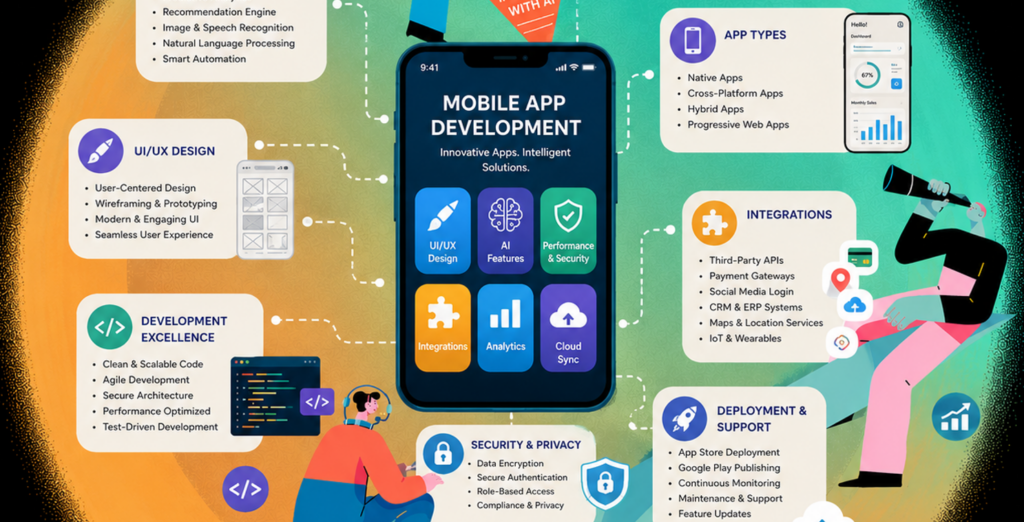
Artificial intelligence is changing the way mobile applications are designed, developed, and used. Mobile apps are moving beyond fixed features and predefined workflows toward experiences that can understand users, automate tasks, generate content, and adapt to changing requirements.
For businesses, AI creates new possibilities for improving mobile products. At the same time, introducing AI into an application brings new technical, security, performance, and product challenges.
The important question is no longer whether AI can be added to a mobile app. It is how AI can be introduced in a useful, secure, and sustainable way.
1. How AI Is Changing Mobile Applications
Traditional mobile applications generally follow predefined rules. A user performs an action, the application processes it, and the system returns a predefined result.
AI introduces a different approach.
Applications can analyze information, identify patterns, understand natural language, generate responses, and make context-based decisions.
AI can support mobile applications through:
- Intelligent search
- AI-powered chat assistants
- Personalized recommendations
- Voice-based interactions
- Image and document analysis
- Automated content generation
- Predictive features
- Smart notifications
- Customer support automation
- Personalized user experiences
This transformation can make mobile applications more responsive to individual users and business requirements.
2. AI-Powered Personalization
One of the major opportunities for AI in mobile development is personalization.
Instead of showing every user the same content or recommendations, an AI-enabled application can use available behavioral information to provide more relevant experiences.
For example, an ecommerce application can improve product discovery, while a content application can adapt recommendations based on user interactions.
Personalization can be applied to:
- Product recommendations
- Content discovery
- Search results
- Notifications
- Offers
- User interfaces
- Customer communication
The objective should be to make the application more useful without making the experience feel intrusive.
3. AI Assistants Inside Mobile Apps
AI assistants are becoming an important application feature.
Instead of navigating through multiple screens, users can interact with an application using natural language.
An AI assistant could help users:
- Find information
- Search products
- Track orders
- Understand account information
- Complete common tasks
- Answer frequently asked questions
- Navigate application features
This changes the interaction model from simply tapping through menus to communicating directly with the application.
4. AI for Mobile Customer Support
Customer support is another area where AI can provide practical value.
Mobile applications can use AI assistants to handle common questions before transferring more complex requests to human support teams.
AI can help with:
- Frequently asked questions
- Product information
- Order-related queries
- Basic troubleshooting
- Account guidance
- Service information
- Support ticket classification
This does not necessarily mean replacing human support. Instead, AI can handle repetitive requests while allowing support teams to focus on issues that require human attention.
5. AI Can Improve the Development Process
AI is not only changing the final mobile application. It is also changing how applications are developed.
Development teams can use AI-assisted tools for activities such as:
- Requirement analysis
- Documentation
- Testing assistance
- Error analysis
- Content generation
- Development research
- Code review assistance
- Project planning
This can help developers spend more time on architecture, product decisions, security, and user experience.
AI should be treated as a development assistant rather than a replacement for engineering judgment.
6. The Challenge of Data Quality
AI systems depend heavily on the information available to them.
Poor-quality, incomplete, outdated, or inconsistent data can result in unreliable outputs.
Businesses introducing AI into mobile applications therefore need to consider:
- Where the data comes from
- Whether the data is accurate
- How frequently it changes
- How it is stored
- Who can access it
- Whether it can legally be used
- How sensitive information is handled
AI implementation should begin with a clear understanding of the data rather than simply selecting an AI model.
7. Privacy and Data Protection
Mobile applications can handle significant amounts of personal and business information.
Adding AI can increase the amount of data processed by external services or backend systems.
Developers therefore need to carefully consider:
- Personal information
- Authentication data
- User-generated content
- Location information
- Business information
- Uploaded documents
- Conversation history
- API communication
Only the information necessary for a specific AI feature should be processed, and appropriate security controls should be applied throughout the system.
8. AI Response Accuracy
AI systems can sometimes produce incorrect, incomplete, or misleading responses.
This creates a challenge when AI becomes part of an application that users depend on for important information.
Applications should therefore provide appropriate safeguards such as:
- Clear system instructions
- Controlled data sources
- Response validation
- Human review where necessary
- Appropriate fallback experiences
- Monitoring and feedback mechanisms
AI should not automatically be given authority to make decisions simply because it can generate an answer.
9. Mobile Performance Challenges
Mobile devices have different hardware capabilities, network conditions, and battery limitations.
Running complex AI operations directly on a device can consume processing power, memory, and battery.
Developers must decide whether AI processing should happen:
- On the mobile device
- On a backend server
- Through an external AI service
- Through a combination of these approaches
The right architecture depends on the application’s requirements, data sensitivity, performance expectations, and cost.
10. AI and Network Dependency
Cloud-based AI features normally require communication between the mobile application and a backend service.
This introduces additional considerations.
Users may experience:
- Slow network connections
- Temporary service interruptions
- API timeouts
- High latency
- Limited connectivity
- Increased data usage
A good mobile application should therefore have a useful experience even when an AI service is temporarily unavailable.
AI should enhance the application rather than become a single point of failure.
11. Managing AI Costs
AI features can introduce new operational costs.
Every AI request may involve processing resources, API usage, data transfer, or infrastructure expenses.
Costs can increase as the number of users and AI interactions grows.
Businesses should consider:
- Expected AI usage
- Number of active users
- Request frequency
- Model selection
- Response size
- Caching opportunities
- Backend infrastructure
- Monitoring and usage limits
An AI feature should have a clear business purpose and measurable value.
12. Choosing the Right AI Model
Not every mobile application requires the most advanced AI model available.
A smaller or specialized model may be sufficient for a particular task and could provide better performance or lower operating costs.
Model selection should consider:
- Required accuracy
- Response speed
- Cost
- Data requirements
- Privacy requirements
- Integration complexity
- Expected usage
- Scalability
The best AI architecture is determined by the application’s requirements, not by the popularity of a particular model.
13. Security Becomes More Important
AI introduces new security considerations into mobile applications.
Developers need to protect:
- Authentication credentials
- API access
- User information
- AI service credentials
- Backend endpoints
- Uploaded files
- Conversation data
- Application business logic
AI services should not be treated as a replacement for conventional application security.
Authentication, authorization, encryption, validation, logging, and secure backend architecture remain important.
14. AI Features Need a Clear Purpose
One of the biggest challenges is adding AI simply because it is popular.
An AI feature should solve a genuine user or business problem.
Before implementation, teams should ask:
- What problem does the AI feature solve?
- Does it improve the user experience?
- Can the result be measured?
- What data does it require?
- What happens when the AI response is incorrect?
- What will the feature cost to operate?
- Can users complete the task without AI?
These questions can prevent unnecessary AI functionality from making the application more complicated.
15. Testing AI-Enabled Mobile Apps
Traditional application testing generally expects predictable results.
AI systems can behave differently depending on the input, context, model, and available information.
Testing therefore needs to consider:
- Different user questions
- Unexpected inputs
- Incorrect information
- Incomplete requests
- Security-related prompts
- Network failures
- Service failures
- Response consistency
- Performance under load
AI testing should focus not only on whether the application works, but also on how safely and reliably it behaves under different conditions.
16. The Importance of Human-Centered AI
AI should improve the relationship between users and the application.
A successful AI feature should feel useful rather than complicated.
Good mobile AI experiences generally provide:
- Clear communication
- Simple interactions
- Fast feedback
- Transparent limitations
- Easy correction
- Human support when required
- Appropriate control for the user
The technology should remain in the background while the user remains in control of the experience.
17. Preparing Existing Mobile Apps for AI
Businesses do not always need to rebuild an existing mobile application to introduce AI.
AI functionality can often be introduced gradually.
A practical approach can include:
- Identifying repetitive user tasks
- Selecting one valuable AI use case
- Preparing the required data
- Connecting the application to a secure backend
- Testing the feature with a limited audience
- Measuring its performance
- Improving the experience based on feedback
- Expanding AI capabilities gradually
This approach can reduce technical risk while allowing businesses to learn how users interact with the new functionality.
18. AI Transformation Is an Ongoing Process
AI technology will continue to evolve.
Models, APIs, development tools, infrastructure, and user expectations can change rapidly.
Mobile applications therefore need an architecture that can adapt.
Businesses should avoid designing AI features so tightly around one technology that replacing or upgrading that technology becomes extremely difficult.
A modular approach can make future improvements easier.